Author: admin

  • My Node.js AI Backend Delivers Real-Time Value: Stop Guessing, Start Shipping Production-Ready Intelligence

    My Node.js AI Backend Delivers Real-Time Value: Stop Guessing, Start Shipping Production-Ready Intelligence

    Scaling AI isn’t about the model—it’s about the infrastructure. Discover how high-performance Node.js backends are operationalizing intelligence for the Fortune 500.

    Synchronizing complex systems requires the precision of a master performer—the same applies to AI orchestration.

    Having guided numerous Fortune 500 companies through their AI transformation, we’ve observed a critical pattern: the success of an AI initiative hinges not on its brilliance, but on its seamless transition from concept to a production-ready system. In the competitive landscape of March 2026, the distance between a successful proof-of-concept (PoC) and a profitable production environment has become the primary battleground for digital leadership.

    TL;DR

    • Production-Ready AI: Moving beyond “throwaway scripts” toward structured, scalable architectures integrated with enterprise operations.
    • Node.js Dominance: With 45%+ adoption, it’s the runtime of choice for non-blocking, real-time AI orchestration. [1]
    • Co-Engineering: Collaborative models mitigate technical debt and accelerate roadmap execution. [2]
    • Agentic Workflows: Modern value is driven by systems that maintain persistent context and execute complex tasks. [3]

    The Chasm Between AI Ambition and Real-World Impact

    As we move through 2026, the “Innovation Theater” phase of artificial intelligence has concluded. For a Chief Technology Officer at a Fortune 500 manufacturing firm, the pressure is no longer just to “do AI,” but to deliver systems that impact the bottom line.

    The challenge is often architectural. A model trained in a Python-heavy data science environment frequently struggles when introduced to the high-concurrency, low-latency requirements of a global supply chain. We have seen organizations invest millions in sophisticated LLM implementations only to find that the resulting “throwaway scripts” cannot scale. [3]

    “We must treat AI not as a standalone ‘brain,’ but as a high-speed nervous system. This requires a shift from model-centric thinking to system-centric engineering.”

    Lesson 1: The ‘Why’ Before the ‘How’ — Aligning AI with Core Business Value

    Before a single line of code is written in our Simform Co-Engineering Center of Excellence, we demand clarity on the value stream. In 2026, the most successful AI implementations in the B2B sector focus on high-stakes operational efficiency.

    Strategic alignment means identifying where latency kills profit. In a predictive maintenance scenario, a delay of even a few seconds in processing sensor data can mean the difference between a controlled shutdown and a catastrophic equipment failure. By focusing on these high-impact use cases, we ensure that the technology serves the strategy.

    Lesson 2: Architecting for Real-Time — Node.js’s Unsung Role in AI Infrastructure

    A person in a car looks intently at a smartphone displaying a navigation app on its screen. They are wearing a dark jacket and holding the phone with one hand.
    Real-time delivery of intelligence requires a backend that can handle simultaneous data streams without missing a beat.

    While Python remains the lingua franca of model training, Node.js has emerged as the premier choice for the orchestration layer. Its event-driven, non-blocking I/O model is uniquely suited for the “agentic” era of AI, where multiple asynchronous calls to LLMs, databases, and APIs must happen simultaneously.

    Metric Value (2026) Significance
    Global Backend Usage 45%+ Top three backend runtime globally [1]
    Ecosystem Maturity v24+ Native support for high-performance streaming
    Deployment Preference Cloud-Native High compatibility with Azure AI and AWS Lambda
    How does Node.js handle Real-Time AI Inference at scale?

    The primary advantage lies in its “Event Loop.” When an agentic AI system calls an LLM, it doesn’t wait for the full response. A Node.js backend can stream tokens directly to the client while simultaneously querying a vector database for context or updating transaction logs. This concurrency is essential for systems that pull real-time weather, fuel prices, and inventory levels concurrently without latency spikes.

    Lesson 3: The Co-Engineering Advantage — Bridging Internal Gaps and Accelerating Roadmaps

    A woman with dark hair and glasses plays an acoustic guitar on a stage. She is focused on strumming the instrument, with a microphone stand visible to her left.
    Collaboration is the key to performance—bridging the gap between internal vision and expert execution.

    Simform’s Co-Engineering model acts as a proactive extension of your internal team. Unlike standard outsourcing, co-engineering involves deep workflow integration, where our engineers work alongside your staff to build and deploy solutions. [2]

    Research into high-growth consultancies shows that global brands in energy and manufacturing rely on these partnerships to deliver high-standard, on-time solutions that internal teams might struggle to execute alone. This mitigates technical debt and ensures AI systems are “engineered” rather than just “working.”

    Lesson 4: Beyond Deployment — Ensuring Sustained Value and Evolution

    Shipping the first version of an AI backend is only the beginning. In 2026, an AI system that doesn’t evolve is a liability. We focus on two key areas:

    • MLOps and Observability: Ensuring models do not drift as data volumes grow.
    • Agentic Evolution: Moving from static chatbots to agents that can perform actions like adjusting a machine’s calibration or updating CRMs. [3]

    Transformative Impact: Quantifiable Success Stories

    Industry trends in 2026 confirm the ROI of these decisions. Predictive AI in large-scale logistics—similar to implementations at Maersk—has led to multi-million dollar savings across maintenance and routing. [4]

    In the B2B SaaS space, firms transitioning from legacy backends to Node.js-based AI microservices have reported a significant increase in deployment frequency and 99.99% reliability even under heavy AI-processing loads. [3]

    What Are the Security Implications of Node.js AI Backends?

    By 2026, the Node.js ecosystem has matured to meet stringent OT/IT requirements. Utilizing Node.js API Gateways allows for centralized authentication and data masking before sensitive information ever reaches an external cloud service. We ensure AI agents operate within a “sandboxed” logic—preventing unauthorized commands on industrial equipment while still allowing for optimization suggestions.

    Frequently Asked Questions

    Is Node.js fast enough for intensive AI computations?

    While Node.js isn’t for training heavy models, it is exceptionally fast at orchestration. Most production AI relies on API-based inference. Node.js excels at managing these asynchronous network calls and streaming responses, making it faster than almost any other runtime for real-time user experiences.

    How does the Co-Engineering model differ from traditional IT outsourcing?

    Traditional outsourcing is often a “black box” hand-off. Simform‘s model is a collaborative partnership. Our experts integrate into your team, following your standards and building internal capabilities while accelerating your roadmap. [2]

    What is “Agentic AI” and why does it need a specialized backend?

    Agentic AI refers to systems that perform tasks (e.g., updating databases) rather than just providing info. They require persistent memory and high concurrency. A Node.js backend handles this complex state management and real-time streaming effortlessly. [3]

    Conclusion: Your Partner in Production-Ready Intelligence

    The landscape of 2026 demands more than just intelligent algorithms; it demands intelligent engineering. The journey from a conceptual PoC to a multi-million dollar profit center requires a strategic choice of architecture and a collaborative approach to development.

    References

    1. Node.js Statistics 2026: Adoption Rate, Enterprise Usage & Insights. Source
    2. How much app development costs – Analysis of Co-Engineering models. PDF Report
    3. AI Evolution: Developers Must Adapt, Not Replace – Gareth Burns, LinkedIn 2026. Discussion
    4. Latest Blog on Custom Web & Mobile Development | SISGAIN AI Trends. Source
    5. E-commerce: Business, Technology, Society – 2026 Perspectives. Textbook

  • My Node.js AI Backend Delivers Real-Time Value: Stop Guessing, Start Shipping Production-Ready Intelligence

    My Node.js AI Backend Delivers Real-Time Value: Stop Guessing, Start Shipping Production-Ready Intelligence

    Scaling AI isn’t about the model—it’s about the infrastructure. Discover how high-performance Node.js backends are operationalizing intelligence for the Fortune 500.

    Synchronizing complex systems requires the precision of a master performer—the same applies to AI orchestration.

    Having guided numerous Fortune 500 companies through their AI transformation, we’ve observed a critical pattern: the success of an AI initiative hinges not on its brilliance, but on its seamless transition from concept to a production-ready system. In the competitive landscape of March 2026, the distance between a successful proof-of-concept (PoC) and a profitable production environment has become the primary battleground for digital leadership.

    TL;DR

    • Production-Ready AI: Moving beyond “throwaway scripts” toward structured, scalable architectures integrated with enterprise operations.
    • Node.js Dominance: With 45%+ adoption, it’s the runtime of choice for non-blocking, real-time AI orchestration. [1]
    • Co-Engineering: Collaborative models mitigate technical debt and accelerate roadmap execution. [2]
    • Agentic Workflows: Modern value is driven by systems that maintain persistent context and execute complex tasks. [3]

    The Chasm Between AI Ambition and Real-World Impact

    As we move through 2026, the “Innovation Theater” phase of artificial intelligence has concluded. For a Chief Technology Officer at a Fortune 500 manufacturing firm, the pressure is no longer just to “do AI,” but to deliver systems that impact the bottom line.

    The challenge is often architectural. A model trained in a Python-heavy data science environment frequently struggles when introduced to the high-concurrency, low-latency requirements of a global supply chain. We have seen organizations invest millions in sophisticated LLM implementations only to find that the resulting “throwaway scripts” cannot scale. [3]

    “We must treat AI not as a standalone ‘brain,’ but as a high-speed nervous system. This requires a shift from model-centric thinking to system-centric engineering.”

    Lesson 1: The ‘Why’ Before the ‘How’ — Aligning AI with Core Business Value

    Before a single line of code is written in our Simform Co-Engineering Center of Excellence, we demand clarity on the value stream. In 2026, the most successful AI implementations in the B2B sector focus on high-stakes operational efficiency.

    Strategic alignment means identifying where latency kills profit. In a predictive maintenance scenario, a delay of even a few seconds in processing sensor data can mean the difference between a controlled shutdown and a catastrophic equipment failure. By focusing on these high-impact use cases, we ensure that the technology serves the strategy.

    Lesson 2: Architecting for Real-Time — Node.js’s Unsung Role in AI Infrastructure

    A person in a car looks intently at a smartphone displaying a navigation app on its screen. They are wearing a dark jacket and holding the phone with one hand.
    Real-time delivery of intelligence requires a backend that can handle simultaneous data streams without missing a beat.

    While Python remains the lingua franca of model training, Node.js has emerged as the premier choice for the orchestration layer. Its event-driven, non-blocking I/O model is uniquely suited for the “agentic” era of AI, where multiple asynchronous calls to LLMs, databases, and APIs must happen simultaneously.

    Metric Value (2026) Significance
    Global Backend Usage 45%+ Top three backend runtime globally [1]
    Ecosystem Maturity v24+ Native support for high-performance streaming
    Deployment Preference Cloud-Native High compatibility with Azure AI and AWS Lambda
    How does Node.js handle Real-Time AI Inference at scale?

    The primary advantage lies in its “Event Loop.” When an agentic AI system calls an LLM, it doesn’t wait for the full response. A Node.js backend can stream tokens directly to the client while simultaneously querying a vector database for context or updating transaction logs. This concurrency is essential for systems that pull real-time weather, fuel prices, and inventory levels concurrently without latency spikes.

    Lesson 3: The Co-Engineering Advantage — Bridging Internal Gaps and Accelerating Roadmaps

    A woman with dark hair and glasses plays an acoustic guitar on a stage. She is focused on strumming the instrument, with a microphone stand visible to her left.
    Collaboration is the key to performance—bridging the gap between internal vision and expert execution.

    Simform’s Co-Engineering model acts as a proactive extension of your internal team. Unlike standard outsourcing, co-engineering involves deep workflow integration, where our engineers work alongside your staff to build and deploy solutions. [2]

    Research into high-growth consultancies shows that global brands in energy and manufacturing rely on these partnerships to deliver high-standard, on-time solutions that internal teams might struggle to execute alone. This mitigates technical debt and ensures AI systems are “engineered” rather than just “working.”

    Lesson 4: Beyond Deployment — Ensuring Sustained Value and Evolution

    Shipping the first version of an AI backend is only the beginning. In 2026, an AI system that doesn’t evolve is a liability. We focus on two key areas:

    • MLOps and Observability: Ensuring models do not drift as data volumes grow.
    • Agentic Evolution: Moving from static chatbots to agents that can perform actions like adjusting a machine’s calibration or updating CRMs. [3]

    Transformative Impact: Quantifiable Success Stories

    Industry trends in 2026 confirm the ROI of these decisions. Predictive AI in large-scale logistics—similar to implementations at Maersk—has led to multi-million dollar savings across maintenance and routing. [4]

    In the B2B SaaS space, firms transitioning from legacy backends to Node.js-based AI microservices have reported a significant increase in deployment frequency and 99.99% reliability even under heavy AI-processing loads. [3]

    What Are the Security Implications of Node.js AI Backends?

    By 2026, the Node.js ecosystem has matured to meet stringent OT/IT requirements. Utilizing Node.js API Gateways allows for centralized authentication and data masking before sensitive information ever reaches an external cloud service. We ensure AI agents operate within a “sandboxed” logic—preventing unauthorized commands on industrial equipment while still allowing for optimization suggestions.

    Frequently Asked Questions

    Is Node.js fast enough for intensive AI computations?

    While Node.js isn’t for training heavy models, it is exceptionally fast at orchestration. Most production AI relies on API-based inference. Node.js excels at managing these asynchronous network calls and streaming responses, making it faster than almost any other runtime for real-time user experiences.

    How does the Co-Engineering model differ from traditional IT outsourcing?

    Traditional outsourcing is often a “black box” hand-off. Simform‘s model is a collaborative partnership. Our experts integrate into your team, following your standards and building internal capabilities while accelerating your roadmap. [2]

    What is “Agentic AI” and why does it need a specialized backend?

    Agentic AI refers to systems that perform tasks (e.g., updating databases) rather than just providing info. They require persistent memory and high concurrency. A Node.js backend handles this complex state management and real-time streaming effortlessly. [3]

    Conclusion: Your Partner in Production-Ready Intelligence

    The landscape of 2026 demands more than just intelligent algorithms; it demands intelligent engineering. The journey from a conceptual PoC to a multi-million dollar profit center requires a strategic choice of architecture and a collaborative approach to development.

    References

    1. Node.js Statistics 2026: Adoption Rate, Enterprise Usage & Insights. Source
    2. How much app development costs – Analysis of Co-Engineering models. PDF Report
    3. AI Evolution: Developers Must Adapt, Not Replace – Gareth Burns, LinkedIn 2026. Discussion
    4. Latest Blog on Custom Web & Mobile Development | SISGAIN AI Trends. Source
    5. E-commerce: Business, Technology, Society – 2026 Perspectives. Textbook

  • Beyond the 12%: The Data-Driven Blueprint Fortune 500 CTOs Use to Guarantee AI Value Capture in 2026

    Beyond the 12%: The Data-Driven Blueprint Fortune 500 CTOs Use to Guarantee AI Value Capture in 2026

    Transforming expensive pilots into quantifiable profit engines in the era of enterprise-scale intelligence.

    A new February 2026 report reveals only 12% of organizations truly achieve AI-driven operations. For the rest, expensive pilots languish. This is not about more investment; it’s about smarter measurement.

    In 2026, we stand at a curious crossroads with enterprise AI. Despite vast investments, a striking truth persists: a recent Thoughtworks and IDC report reveals only 12% of organizations truly achieve AI-driven operations. This isn’t a story of technical failure, but often one of strategic disconnect. We must look ‘Beyond the 12%’ to uncover the data-driven blueprint that guarantees AI value capture, moving from hopeful pilots to undeniable profit.

    This post will equip Fortune 500 CTOs with the precise, data-backed strategies and key performance indicators (KPIs) that differentiate the top 12% of AI value capturers. Learn how to transition from fragmented pilots to quantifiable business outcomes, leveraging critical metrics like ‘cycle time,’ ‘cost per transaction,’ and ‘revenue per rep’ to prove and scale AI’s impact.

    Why This Matters: The Urgency for Quantifiable AI Value

    For Chief Technology Officers within Fortune 500 manufacturing companies, the stakes of AI adoption are immense. We are navigating an era where agile, tech-forward competitors are disrupting traditional industries with superior digital products and experiences, a trend keenly observed in discussions about digital manufacturing in 2026.

    Yet, the disheartening statistics paint a challenging picture. While traditional technology adoption once had a failure rate of approximately 42%, the addition of digital, data, or AI to the mix often doubles these rates. Some analyses even suggest that as high as 88% of enterprise AI initiatives fail to deliver substantial value.

    The disconnect often lies not in the potential of AI itself, but in the journey from initial proof-of-concept to systemic, measurable enterprise AI value capture.

    The Blueprint for Guaranteed AI Value Capture

    A woman in a formal dress plays a cello on stage, bowing the instrument while a microphone captures the sound.

    The transition from AI aspiration to operational reality demands more than just technology; it requires a strategic framework that aligns innovation with tangible business impact.

    1. Strategic Alignment: Beyond the Pilot Phase

    Visionary CTOs embed AI within the overarching business strategy from inception. This means identifying pain points where AI acts as a force multiplier across entire value chains, not just within individual departments.

    Consider the breakthrough of a manufacturing giant that integrated predictive maintenance AI directly into supply chain optimization. This systemic re-envisioning, supported by Simform’s expertise in digital product engineering, ensures AI solutions are designed for ecosystem integration from day one.

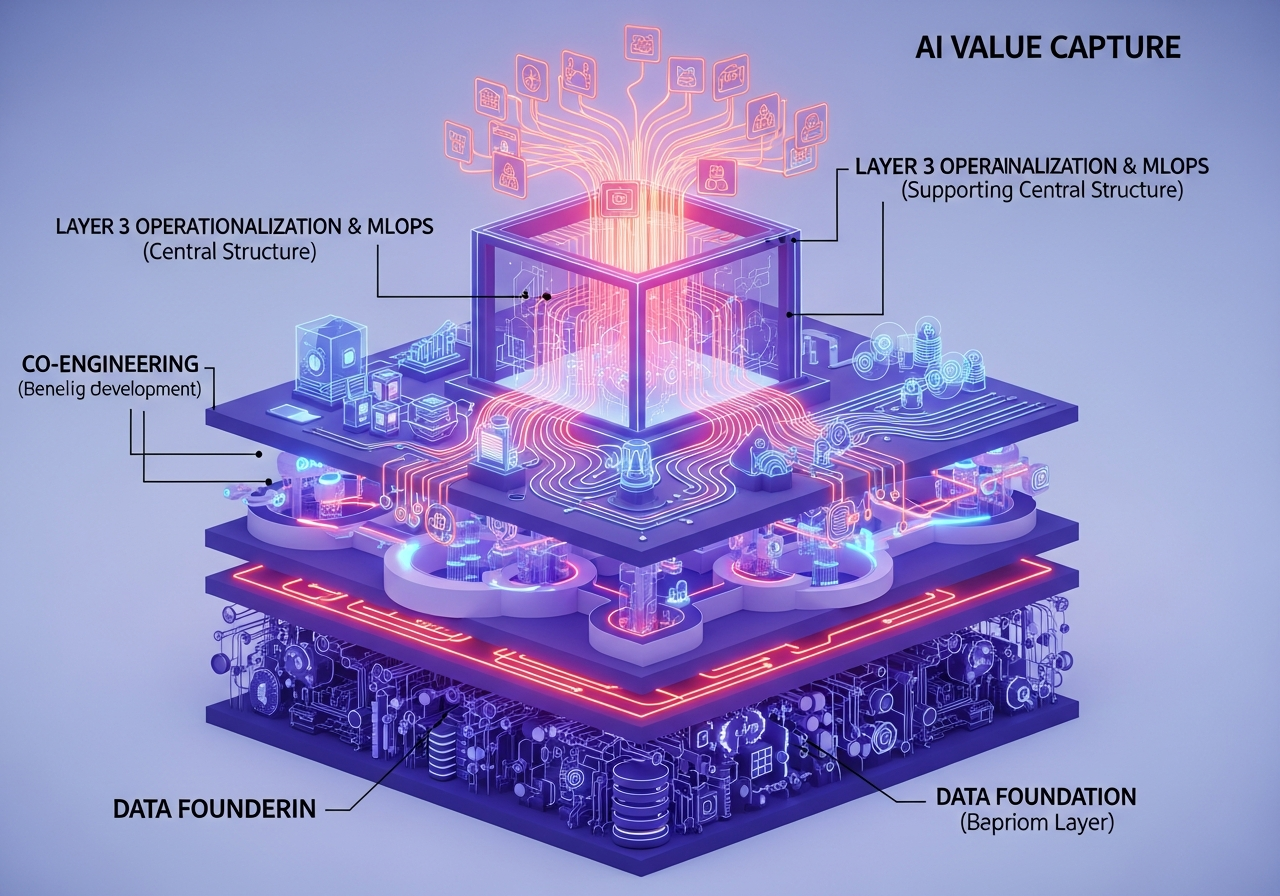
    2. The Data Foundation: The Unsung Hero

    AI models are only as effective as the data they consume. Leading organizations invest proactively in robust data engineering to ensure:

    • Data Integration: Breaking down silos for a unified view.
    • Governance: Ensuring accuracy and compliance.
    • AI-Ready Pipelines: Automated raw-to-ML transformations.

    3. The Co-Engineering Imperative

    As Nick Colisto, SVP and CIO at Avery Dennison Corporation, advises, “aim to buy about 80% of the capabilities you need and build the remaining 20%… don’t reinvent what’s already working elsewhere.” Embracing a Co-Engineering & Innovation Lab model allows internal teams to converge with specialized external experts to shorten development cycles.

    Expert Insight: Precise Metrics for AI Value Capture

    A smiling Black woman in a camouflage military uniform, with her dark hair pulled back, stands outdoors against a blurry green background.

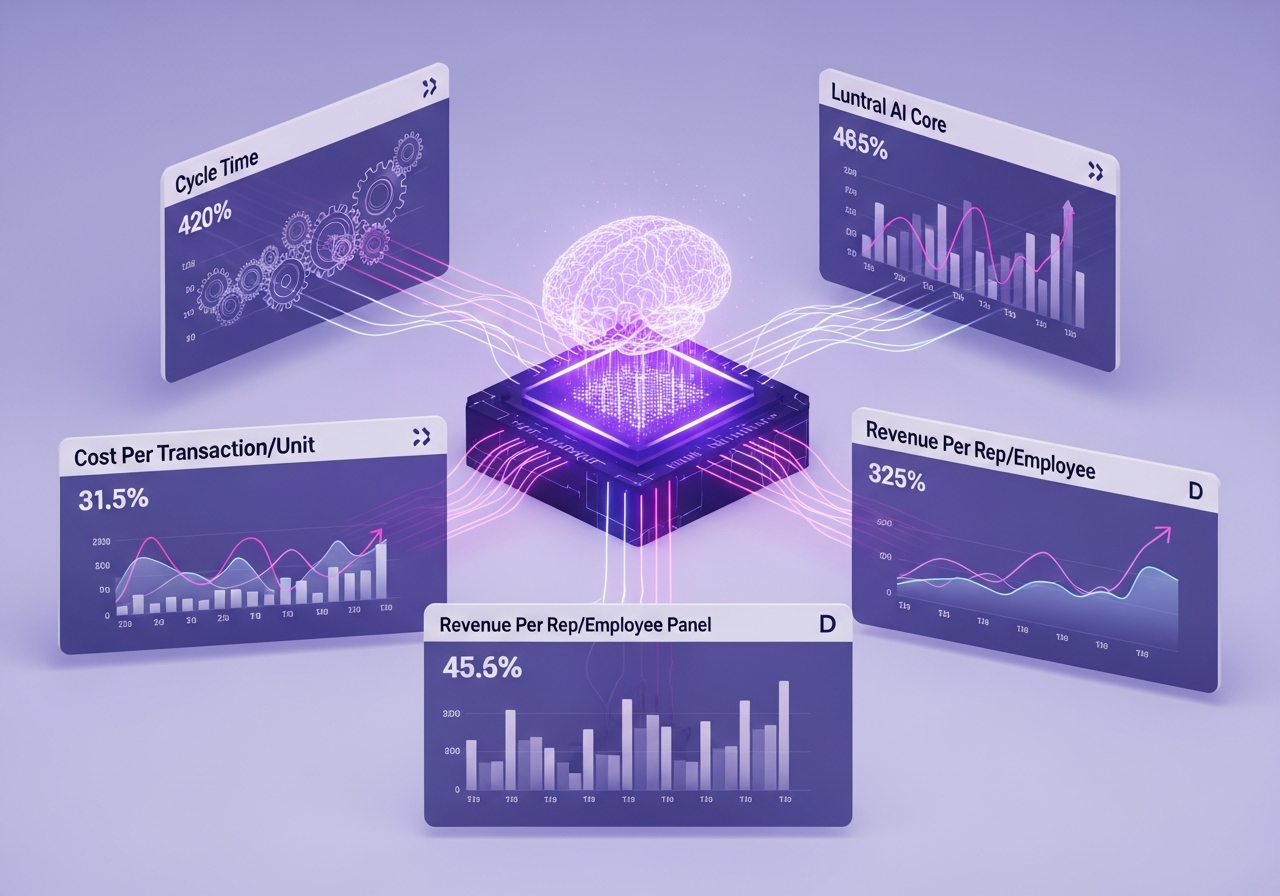
    1. Redefining Success: Business KPIs Over Vanity Metrics

    Cycle Time

    Reducing the time from raw material input to finished product. proprietary models at Ford can now simulate aerodynamic drag in seconds vs. 18 hours.

    Cost Per Unit

    Decreasing expenditure per produced item through AI-driven process optimization and predictive maintenance.

    Revenue Per Rep

    Enhancing productivity by streamlining tasks with AI assistants, allowing experts to focus on high-value decision making.

    “Our ‘AI Big Bets’ all have stringent financial analysis, and already have outsized value. But our success metrics aren’t just financial. We also look at agility and speed.” — Franziska Bell, Chief Data and AI Officer at Ford Motor Company.

    2. A Phased Approach to ROI

    Adopt a framework where early experimentation is encouraged, but pathways to value are non-negotiable:

    Stage 1: Experimentation & PoC

    Focus on technical feasibility and initial problem validation. Use this phase to identify which “Big Bets” have the potential for enterprise-wide scaling.

    Stage 2: Pilot & Measurement

    Introduce initial KPIs like cycle time reduction in a specific process to build the internal business case.

    Stage 3: Scale & Enterprise Integration

    Apply stringent ROI analysis. Leverage Simform’s managed sustenance services to maintain and evolve these assets for long-term returns.

    Conclusion: Orchestrating AI for Undeniable Profit

    The narrative of enterprise AI in 2026 is being written by those who move beyond isolated successes. By laying robust data foundations, balancing build vs. buy via co-engineering, and measuring impact with surgical precision, Fortune 500 leaders are turning AI from a cost center into a strategic advantage.

    Ready to move beyond the 12%? Implementing robust MLOps and Cloud engineering is the final step in transforming your AI vision into a continuously evolving, value-generating asset.

    Explore Our AI Co-Engineering Lab

  • Decoding Google’s AI Overviews: Data-Driven Strategies for 2026 Search Impact

    Decoding Google’s AI Overviews: Data-Driven Strategies for 2026 Search Impact

    Navigating the shift from organic rankings to AI citations with specialized, integrated technical demos.

    As a Developer Advocate, the 2026 search landscape, dominated by AI Overviews, felt like a double-edged sword: powerful answers, but fewer reasons for users to click through. My challenge? To build a compelling demo that showcases why developers still need deep, specialized AI solutions. This is the story of how I did it, using Leap AI.

    Why the 2026 AI Overview Landscape Demands Deeper Integration

    A woman in a dark, off-the-shoulder dress smiles warmly at the camera, holding a white smartphone with both hands in front of her against a softly blurred background.

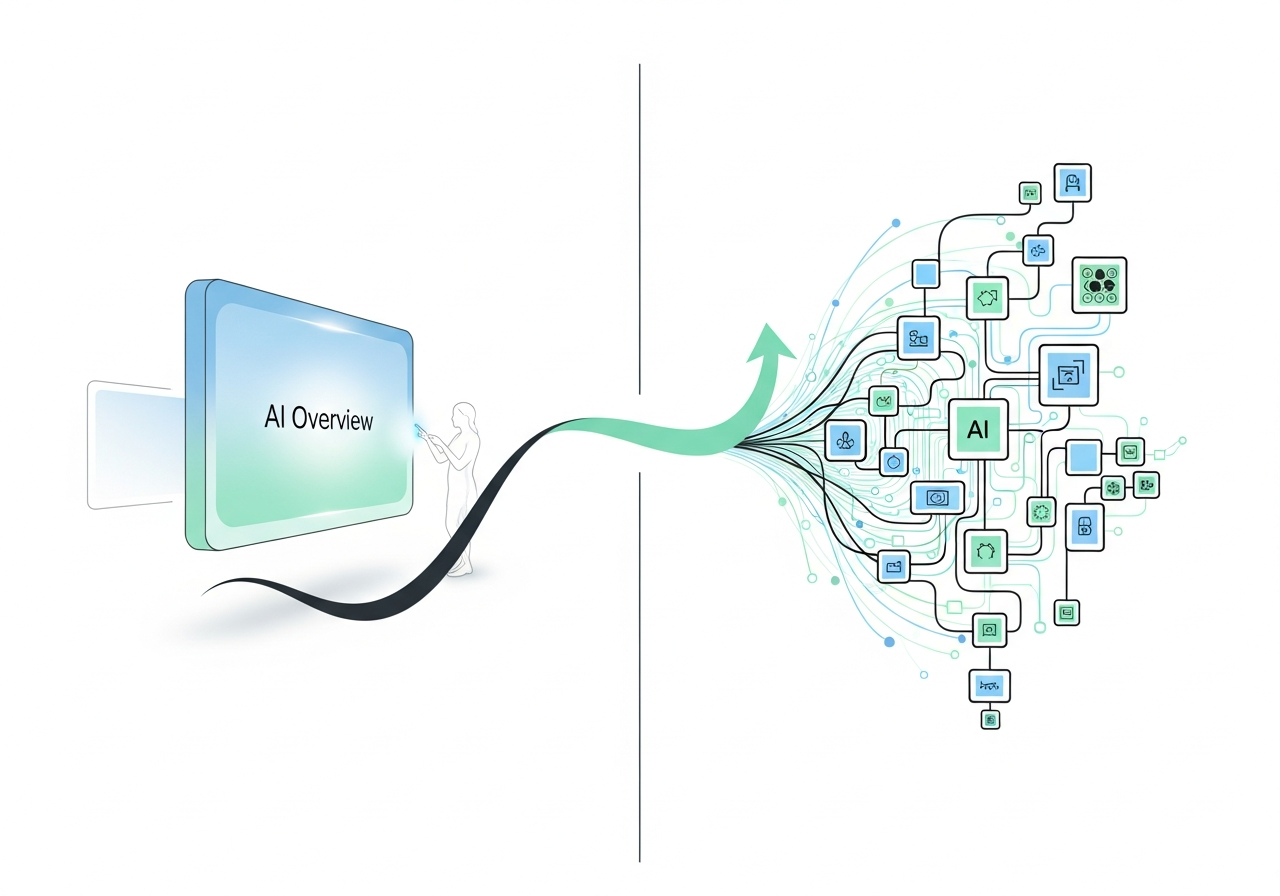
    The evolution of Google’s AI Overviews in 2026 represents a significant architectural shift in information retrieval. With over 88% of searches that trigger AI Overviews being informational, their prominence ensures brand visibility, yet their design simultaneously reduces the imperative for users to navigate away from the SERP. Data indicates that when Google provides an AI summary, only 8% of users click on the traditional organic search results below it [26 AI SEO Statistics for 2026 – Semrush]. This structural impedance to direct traffic presents a critical challenge for SaaS businesses.

    “When Google AI Overviews appear on high volume queries, growth leaders feel it as a forecasting problem, a brand accuracy problem, and a conversion problem inside organic search. The bigger shift is behavioral: the results page resolves more questions before anyone visits a site.”

    — Arman Tale, Operations Director at Brand Vision

    Generic AI answers, while broadly accessible, frequently miss the nuance required for specialized, high-stakes applications. Large Language Models (LLMs) offer strategic value, but their limitations in precision, deterministic extraction, layout interpretation, cost efficiency, and regulatory compliance become pronounced in high-volume, production-grade document automation workflows [The Capabilities and Limitations of LLMs]. This deficiency underscores the imperative for developers to implement AI solutions that extend beyond the capabilities of a generalized AI Overview.

    “Visibility is no longer earned solely through ranking positions, but through being recognized as a reliable source worth citing. In AI-driven search, visibility and trust matter more than raw traffic numbers. Clarity consistently outperforms creativity.”

    — Lauren Chervinski, AI SEO Specialist

    From Query to Code: Building ‘AI Overviews Beyond the Basics’ with Leap AI

    A smiling East Asian woman with dark, shoulder-length hair stands, looking to her right. She wears a white ruffled blouse and a delicate necklace, in a blurred office setting.

    To navigate this paradigm shift, we conceptualized and developed a framework: “AI Overviews Beyond the Basics.” The objective was to create a proof-of-concept (PoC) that leveraged Leap AI‘s capabilities to overcome the inherent limitations of generalized AI summaries.

    Phase 1: Deconstructing the Challenge

    Standard RAG implementations often fall short when confronted with specialized domain knowledge. Our assessment identified key limitations in current generic AI Overviews:

    • Contextual Hallucinations: Lack of grounding in proprietary data.
    • Lack of Depth: Missing actionable code snippets and architectural diagrams.
    • Limited Modality: Purely text-based responses for complex visual systems.
    • Infrastructure Overhead: High costs of scaling custom MLOps.
    Phase 2: Architectural Scaffolding with Leap AI

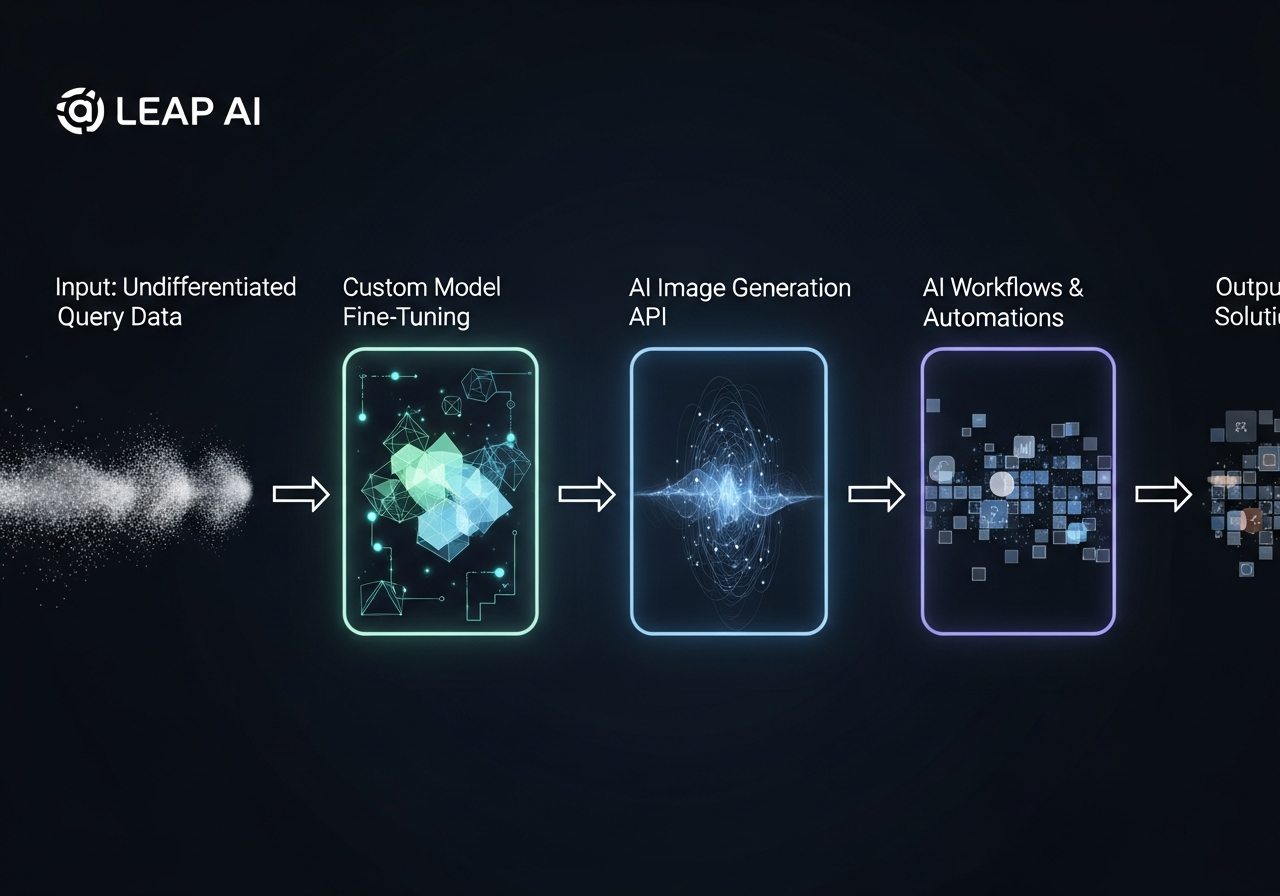
    We utilized four core pillars of the Leap AI platform:

    1. Custom Fine-Tuning: Resolving domain-specific queries with precision.
    2. Advanced Image APIs: Generating dynamic system architecture diagrams via Stable Diffusion XL.
    3. AI Workflows: Connecting models to Vercel and GitHub for immediate action.
    4. Cost Optimization: Leveraging a pay-per-service model to stay agile.

    Building ‘AI Overviews Beyond the Basics’ – A Practical Implementation

    Contextual Richness via Custom Models

    A developer query such as “How do I implement multi-tenant authentication using our API and Next.js?” no longer receives a generic explanation. By fine-tuning on internal docs through Leap AI, our system provides specific TypeScript snippets and security best practices derived from internal audits.

    Multi-Modal Enhancement for Clarity

    Using Leap AI’s Image Generation APIs, queries regarding “data pipelines” automatically generate visual representations. This transforms abstract concepts into immediately comprehensible system architecture diagrams, accelerating understanding for Lead Developers and CTOs.

    Workflow Automation for Actionable Insights

    We configured workflows where a query for “automating release notes” triggers code analysis, SEO-optimized content synthesis via the AI Content Generation API, and an automatic push to a staging environment. We move from answers to actions.

    Conclusion

    The 2026 search landscape, heavily influenced by Google’s AI Overviews, presents both a challenge and an unparalleled opportunity for SaaS companies. While generic AI summaries satisfy broad informational queries, they necessitate a re-evaluation of how specialized technical solutions are surfaced and adopted.

    By leveraging an integrated AIPaaS like Leap AI for custom model fine-tuning and multi-modal generation, we are not merely adapting. We are actively creating solutions that possess unique contextual depth and practical utility. Interactive API consoles and functional demos have been shown to significantly increase activation rates [Technical Demos Need Less Talk – LinkedIn].

    The future of search demands a proactive, technically rigorous development posture. By embracing platforms like Leap AI, developers are positioned not just to adapt, but to actively sculpt the next generation of search experiences.

    Ready to move beyond the summary? Explore how Leap AI can power your next-generation developer experience today.

  • Hello world!

    Welcome to WordPress. This is your first post. Edit or delete it, then start writing!