Navigating the shift from organic rankings to AI citations with specialized, integrated technical demos.
As a Developer Advocate, the 2026 search landscape, dominated by AI Overviews, felt like a double-edged sword: powerful answers, but fewer reasons for users to click through. My challenge? To build a compelling demo that showcases why developers still need deep, specialized AI solutions. This is the story of how I did it, using Leap AI.
Why the 2026 AI Overview Landscape Demands Deeper Integration
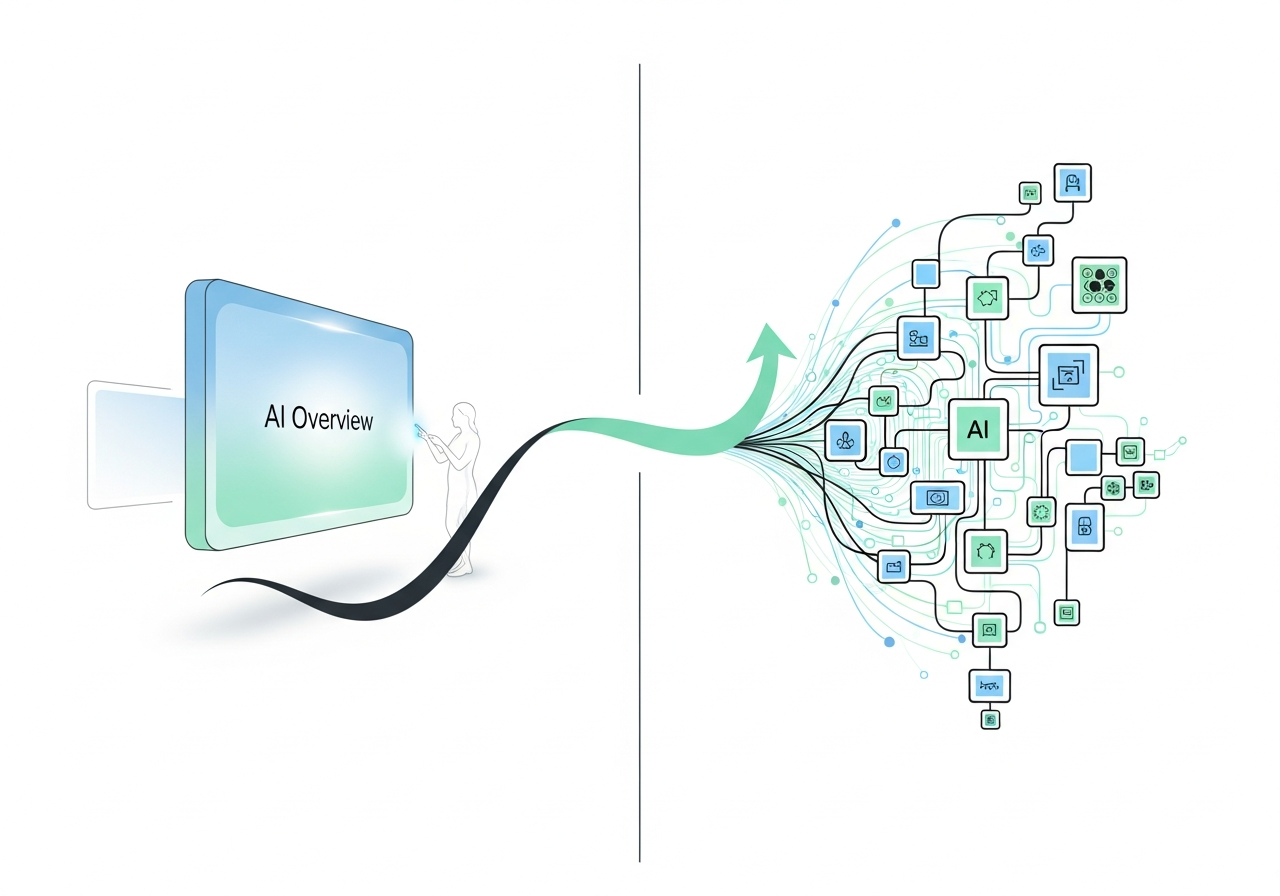
The evolution of Google’s AI Overviews in 2026 represents a significant architectural shift in information retrieval. With over 88% of searches that trigger AI Overviews being informational, their prominence ensures brand visibility, yet their design simultaneously reduces the imperative for users to navigate away from the SERP. Data indicates that when Google provides an AI summary, only 8% of users click on the traditional organic search results below it [26 AI SEO Statistics for 2026 – Semrush]. This structural impedance to direct traffic presents a critical challenge for SaaS businesses.
“When Google AI Overviews appear on high volume queries, growth leaders feel it as a forecasting problem, a brand accuracy problem, and a conversion problem inside organic search. The bigger shift is behavioral: the results page resolves more questions before anyone visits a site.”
— Arman Tale, Operations Director at Brand Vision
Generic AI answers, while broadly accessible, frequently miss the nuance required for specialized, high-stakes applications. Large Language Models (LLMs) offer strategic value, but their limitations in precision, deterministic extraction, layout interpretation, cost efficiency, and regulatory compliance become pronounced in high-volume, production-grade document automation workflows [The Capabilities and Limitations of LLMs]. This deficiency underscores the imperative for developers to implement AI solutions that extend beyond the capabilities of a generalized AI Overview.
“Visibility is no longer earned solely through ranking positions, but through being recognized as a reliable source worth citing. In AI-driven search, visibility and trust matter more than raw traffic numbers. Clarity consistently outperforms creativity.”
— Lauren Chervinski, AI SEO Specialist
From Query to Code: Building ‘AI Overviews Beyond the Basics’ with Leap AI
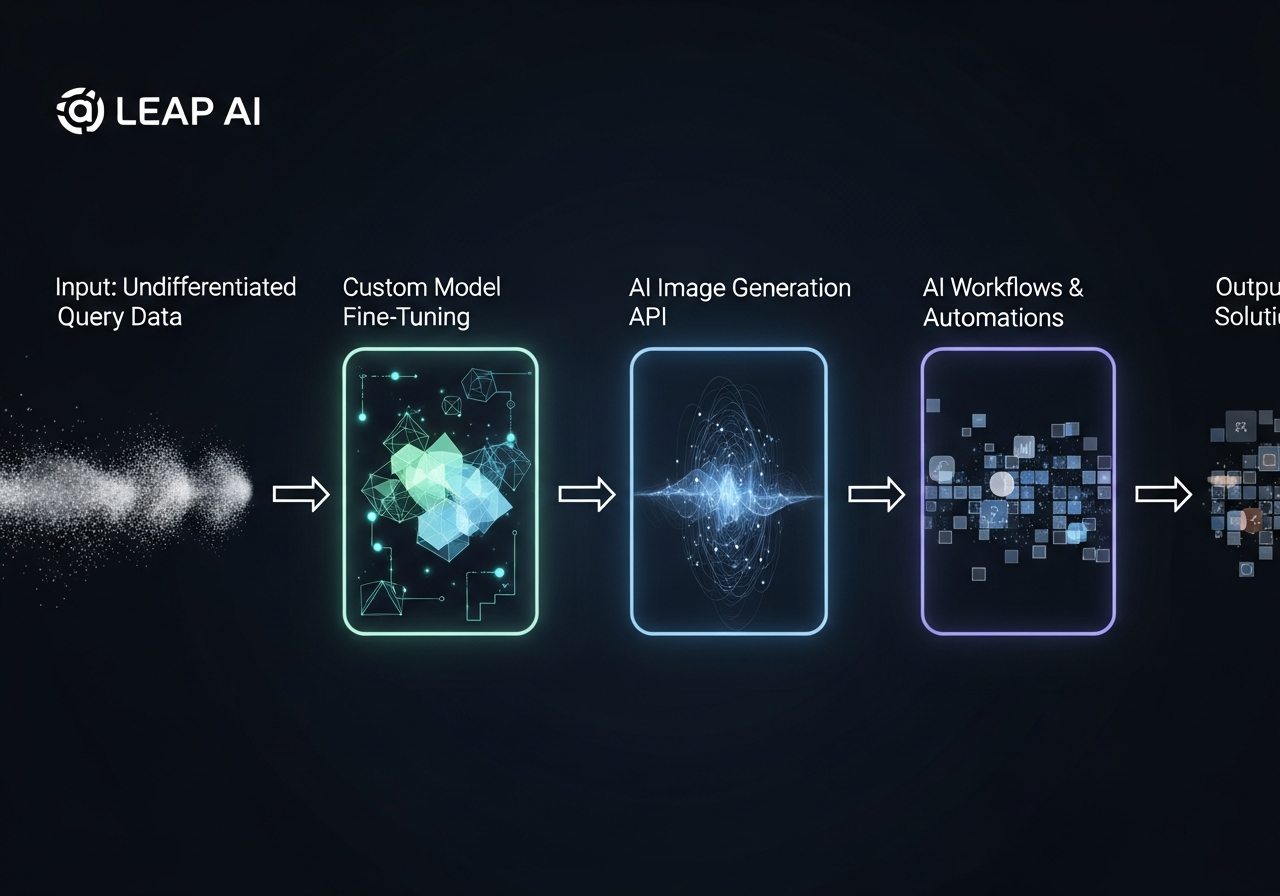
To navigate this paradigm shift, we conceptualized and developed a framework: “AI Overviews Beyond the Basics.” The objective was to create a proof-of-concept (PoC) that leveraged Leap AI‘s capabilities to overcome the inherent limitations of generalized AI summaries.
Phase 1: Deconstructing the Challenge
Standard RAG implementations often fall short when confronted with specialized domain knowledge. Our assessment identified key limitations in current generic AI Overviews:
- Contextual Hallucinations: Lack of grounding in proprietary data.
- Lack of Depth: Missing actionable code snippets and architectural diagrams.
- Limited Modality: Purely text-based responses for complex visual systems.
- Infrastructure Overhead: High costs of scaling custom MLOps.
Phase 2: Architectural Scaffolding with Leap AI
We utilized four core pillars of the Leap AI platform:
- Custom Fine-Tuning: Resolving domain-specific queries with precision.
- Advanced Image APIs: Generating dynamic system architecture diagrams via Stable Diffusion XL.
- AI Workflows: Connecting models to Vercel and GitHub for immediate action.
- Cost Optimization: Leveraging a pay-per-service model to stay agile.
Building ‘AI Overviews Beyond the Basics’ – A Practical Implementation
Contextual Richness via Custom Models
A developer query such as “How do I implement multi-tenant authentication using our API and Next.js?” no longer receives a generic explanation. By fine-tuning on internal docs through Leap AI, our system provides specific TypeScript snippets and security best practices derived from internal audits.
Multi-Modal Enhancement for Clarity
Using Leap AI’s Image Generation APIs, queries regarding “data pipelines” automatically generate visual representations. This transforms abstract concepts into immediately comprehensible system architecture diagrams, accelerating understanding for Lead Developers and CTOs.
Workflow Automation for Actionable Insights
We configured workflows where a query for “automating release notes” triggers code analysis, SEO-optimized content synthesis via the AI Content Generation API, and an automatic push to a staging environment. We move from answers to actions.
Conclusion
The 2026 search landscape, heavily influenced by Google’s AI Overviews, presents both a challenge and an unparalleled opportunity for SaaS companies. While generic AI summaries satisfy broad informational queries, they necessitate a re-evaluation of how specialized technical solutions are surfaced and adopted.
By leveraging an integrated AIPaaS like Leap AI for custom model fine-tuning and multi-modal generation, we are not merely adapting. We are actively creating solutions that possess unique contextual depth and practical utility. Interactive API consoles and functional demos have been shown to significantly increase activation rates [Technical Demos Need Less Talk – LinkedIn].
The future of search demands a proactive, technically rigorous development posture. By embracing platforms like Leap AI, developers are positioned not just to adapt, but to actively sculpt the next generation of search experiences.
Ready to move beyond the summary? Explore how Leap AI can power your next-generation developer experience today.
Leave a Reply